

Sharing real-time video between Windows applications with Spout
Scope supports near-zero latency video sharing with other local applications on Windows via Spout. This enables powerful workflows like sending Scope’s output to TouchDesigner, Unity, or Blender in real-time.What is Spout?
Spout is a real-time video sharing framework for Windows that allows applications to share GPU textures with minimal overhead. Unlike screen capture or video streaming, Spout shares frames directly through GPU memory, resulting in:- Near-zero latency - Frames are available instantly
- Full quality - No compression artifacts
- Minimal CPU overhead - All processing stays on the GPU
Spout Receiver
Configure Scope to receive video from other applications via Spout. This is useful for using external video sources (like TouchDesigner or OBS) as input for your generations.1
Set input mode to Video
Under Input & Controls, set Input Mode to Video.
2
Select Spout as source
Set Video Source to Spout Receiver.
3
Configure sender name (optional)
The Sender Name field can be: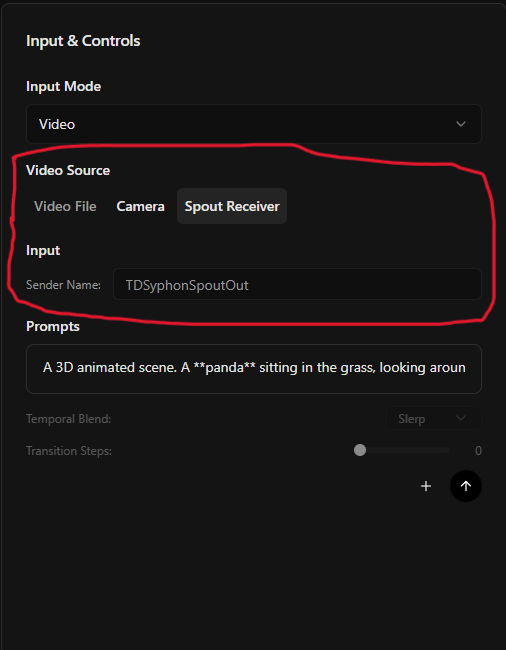
- Empty - Receive from any available Spout sender
- Specific name - Receive only from a sender with that exact name
Spout Sender
Configure Scope to send its output to other applications via Spout. This is useful for post-processing in TouchDesigner, recording in OBS, or using Scope’s output in Unity/Unreal projects.1
Open Settings
Click the Settings panel in the Scope interface.
2
Enable Spout Sender
Toggle Spout Sender to On.
3
Configure sender name (optional)
The default sender name is 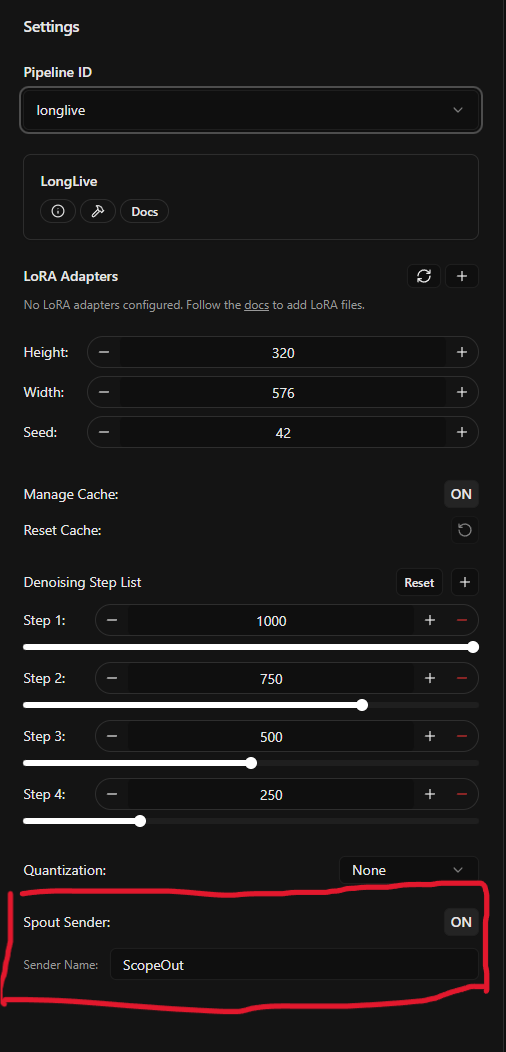
ScopeOut. You can change this if you need to identify multiple Scope instances.Compatible Applications
Scope can share real-time video with any application that supports Spout. The following applications have been tested:TouchDesigner
Use Syphon Spout In and Syphon Spout Out TOPs
Resolume Arena / Avenue
Built-in Spout input/output
OBS Studio
With the Spout2 plugin
Unity
Use the KlakSpout plugin
Blender
Use the TextureSharing add-on
Example: TouchDesigner Integration
This example shows Scope sending real-time AI video to TouchDesigner for further processing and output.Basic Setup
- In Scope, enable Spout Sender with name
ScopeOut - In TouchDesigner, add a Syphon Spout In TOP
- Set the source to
ScopeOut - The AI-generated video now flows into your TouchDesigner network
Use Cases
Live VJ Performance
Use TouchDesigner to mix Scope’s output with other visuals, apply effects, and output to projectors or LED walls
Interactive Installations
Combine Scope with TouchDesigner’s sensor inputs for reactive AI art
Broadcast Graphics
Route Scope through TouchDesigner to NDI or SDI for live broadcast
Game Development
Use Unity or Unreal to incorporate real-time AI video into game environments
Troubleshooting
Spout sender not appearing in other apps
Spout sender not appearing in other apps
- Verify Spout Sender is enabled in Scope settings
- Make sure both applications are running on the same Windows machine
- Try restarting the receiving application after enabling Spout in Scope
Spout receiver not getting video
Spout receiver not getting video
- Verify the sending application has Spout output enabled
- Check that the sender name matches (or leave empty to receive from any sender)
- Ensure both applications are using the same Spout version
Performance issues
Performance issues
- Spout sharing is GPU-memory based and should have minimal overhead
- If you see frame drops, check GPU memory usage - you may need to reduce resolution
- Close other GPU-intensive applications if VRAM is limited
See Also
Using Syphon
The macOS equivalent of Spout for sharing real-time video between applications
Using NDI
Send and receive real-time video over the network across machines
Quick Start
Get Scope running if you haven’t already
VACE Guide
Use reference images and control videos with Spout input